Production: A Woman Alone By: Tracey Saunders Photos: Provided
In A Woman Alone,Kim Engelbrecht is singular in her presence but she represents a multiplicity of women across place and time as she rages against patriarchy in a domestic unravelling of slow-burning chaos, writes Tracey Saunders.
An ordinary suburban apartment, the conventional accoutrements of domesticity and prosaic background music lull you into a false sense of comfort when you enter the theatre.
This deceptive domestic bliss is quickly shattered and revealed as a site of abuse, defilement and slow-burning rage. Not long after the house lights dim, it is clear why a play written in Italian in 1977 is being staged at a South African festival in 2026. In a week when the president felt shocked enough to comment on the national epidemic of violence against women and the international media is saturated with the lacklustre response to rape at Cornell University, A Woman Alone is sadly a timely reminder of what remains unchanged. Since the original staging in the 1970s, lingerie is more likely to be ordered from Shein, not Littlewoods; the rotary phone has been replaced by the ubiquitous mobile one, and stalking can be both online and in person, but the much-hailed emancipation of women hasn’t borne quite as much fruit as promised.
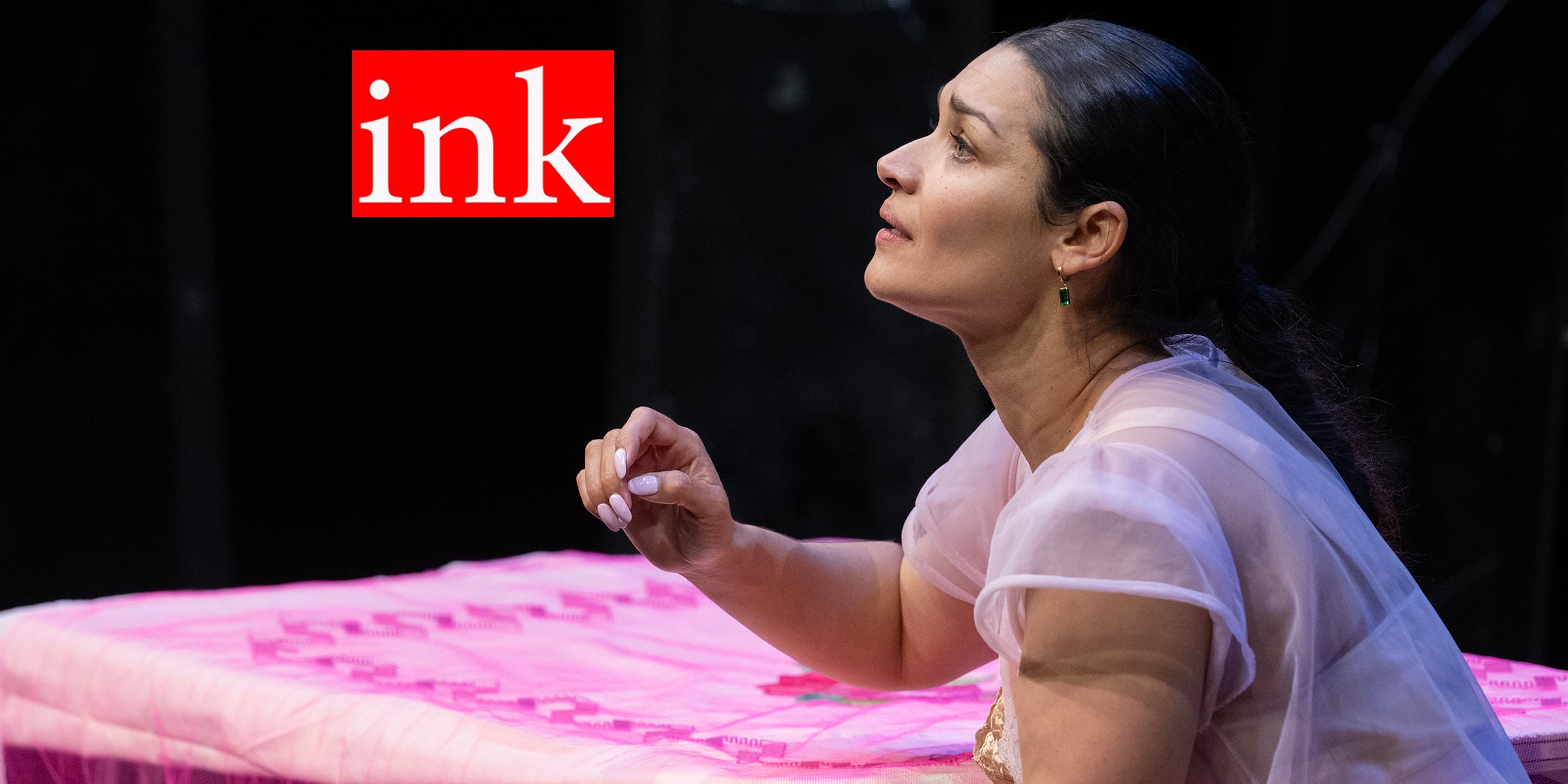
We encounter Sharon, wound tightly in layers of clothing, unable to see, her breathing laboured and her movement stifled – the subtext of the script presented in one indelible image. She divests herself of the layers of clothing (mostly male, with the exception of a cream satin slip) to the sound of Whitney Houston’s “Saving All My Love for You”. She slowly unwinds each item – a flirtatious sequence with a pair of trousers, gagging at the stench of a jacket – each piece discarded until she is exposed, dressed in a lacy negligee set and a comfortable dressing gown. As the play unfolds, she unravels layers of misogyny and abuse, casual and cruel, with a similar, deliberate intensity. The jarring sound of Skunk Anansie’s “Yes It’s Fucking Political” provides another marker, albeit unnecessary, that this is indeed political.
The jarring sound of Skunk Anansie’s ‘Yes It’s Fucking Political’ provides another marker, albeit unnecessary, that this is indeed political.
The fourth wall is quickly broken as she greets her neighbour across the way. The banter between her and the unseen witness provides some of the most pointed social commentary. The intriguing and questionable aspect is the audience as bystanders, providing stereotypical yet unhelpful advice such as “tell your husband” or “call the police”. Her initial pronouncements that she is “very well cared for” by a very attentive husband who “provides her with everything” are soon revealed to be unreliable.
Beset by the tentacles (metaphorical and literal) of patriarchy, misogyny and insidious sexual violence on every side, Sharon is a woman who is on her own, but not alone. If it’s not her possessive husband or an obscene caller phoning her several times a day, or her physically injured and depraved brother-in-law groping her from his wheelchair, it’s the neighbourhood voyeur, leering into her kitchen window. Every man she encounters has used or abused her and adds another bar to the prison of patriarchy in which she is captured. Even her brief, tantalising moment of respite and “true love”, which provides a taste of sexual liberation, is cut short and subsequently tainted.
She’s been suicidal, driven to drink, Campari, of course, and swallowed an inordinate number of pills – and yet, she persists. With wry dark humour, she shares the onslaughts in anecdotes, and we witness first-hand her encounters as she grapples with her brother-in-law inside the apartment and her scorned young lover at the door. Engelbrecht’s performance delivers the perfect pitch of farce without becoming farcical. Her quiet hysteria unravels with beguiling and measured intensity, and she avoids falling into a soap opera rendition of a crazy housewife. She is relatable and, judging by several sounds of assent from the audience, entirely recognisable.
The soundscape is as elemental as the set, and there are frequent musical interjections, some adding an ironic twist: George Michael’s “Careless Whisper” as her brother-in-law’s clarion trumpet call, Joni Mitchell’s haunting “Both Sides Now” mocking her discovery of love. The music choices are deliberate, acting as directional cues, with the lyrics providing additional, pointed satirical commentary. The frenzied cacophony builds to a crescendo as everybody demands everything all at once. The lyrics of “(I Love You and) Don’t You Forget It” are reprised as a quiet and steady stillness descends, and Engelbrecht delivers a denouement you won’t easily forget.
This staging of A Woman Alone is part of the centenary celebration launched by the Fo-Rame Foundation (Fondazione Fo Rame ETS) to mark the 100th anniversary of Dario Fo’s birth on 24 March 1926.
A Woman Alone 4 OCT 19:00 | 6 OCT 17:30 Adam Small Laboratory R210-R260 | R240-R290 at the door