SPIER TONEEL
Andrew Buckland: ‘Lag is ’n fisieke reaksie’
Deur: Marina Griebenow
Foto’s: AB Jantjies
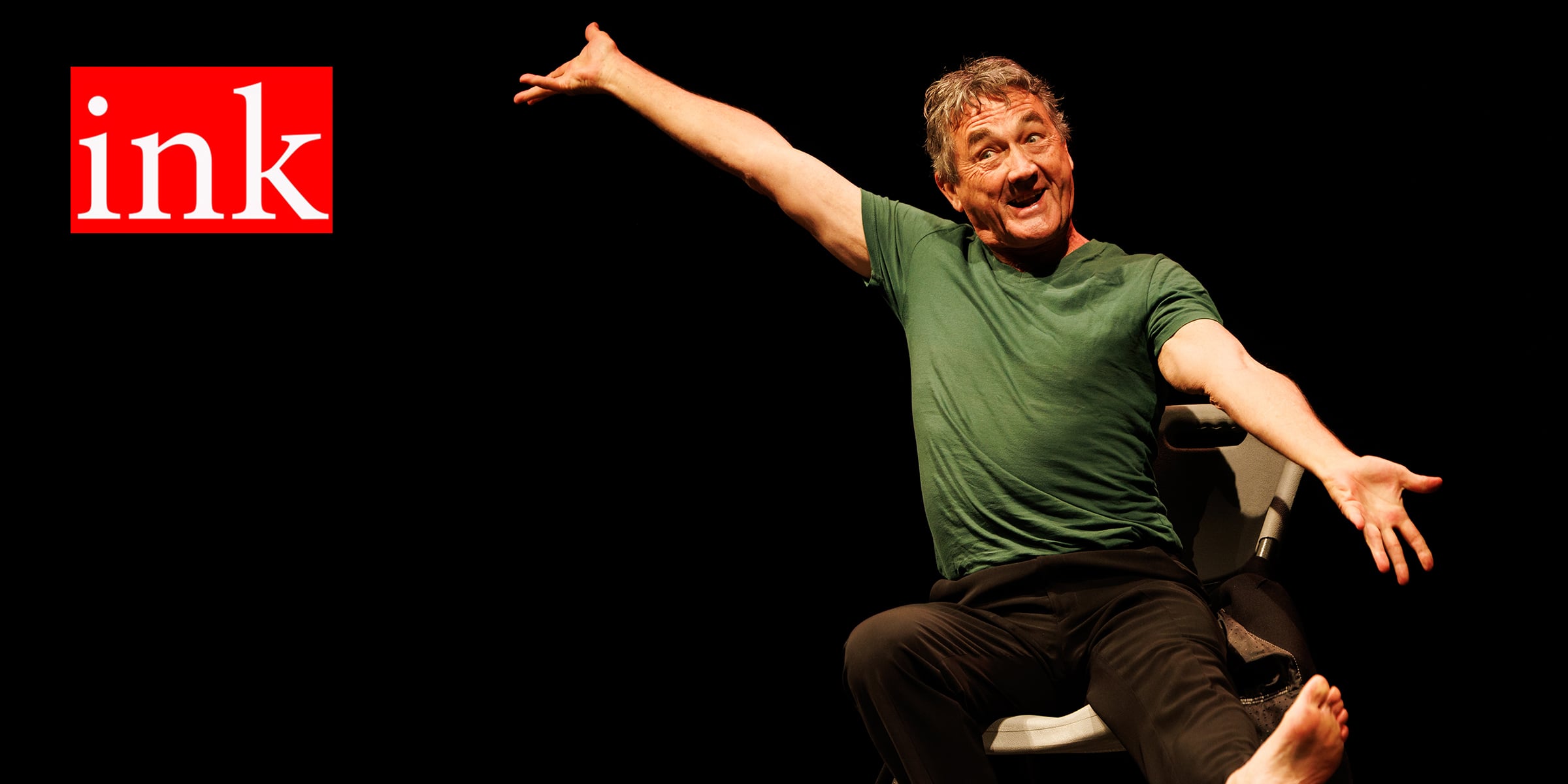
Die teaterlegende Andrew Buckland vertolk al die karakters in sy Kanna-bekroonde stuk The Fool’s Guide… to Living and Dying wat by die Toyota Stellenbosch Woordfees op die planke is. Marina Griebenow het hom uitgevra oor hoe komedie en gehore in sy lang loopbaan van meer as 40 jaar verander het.
As jy al The Fool’s Guide… to Living and Dying beleef het, haal jy die herinneringe daaraan so nou en dan uit, soos ’n mooi diamant, poets dit liggies en verlustig jou dan weer in wat die stuk sê omtrent die menslike kondisie in al sy gebrokenheid en die wêreld waarin ons al hoe meer ontuis voel. Bowenal getuig dit van Andrew Buckland se meesterskap as fisieke akteur en mimikus asook sy vlytige verbeelding waarmee hy wêrelde groot en klein skep om ons te vermaak én vermaan.
Andrew het vanjaar met sy vertolking in The Fool’s Guide die Kanna as beste akteur by die KKNK gewen. By die Nasionale Kunstefees in Makhanda verlede jaar het die regisseur, Janet Buckland, op haar beurt ’n Standing Ovation-toekenning ontvang vir haar bydrae tot die fees oor baie jare, maar spesifiek ook vir haar regie van The Fool’s Guide.
Die stuk handel oor die frenetiese pogings van ene Milton om sy seun, Billy Yonaire, uit die kloue van ’n klomp tech-booswigte te verlos. In die proses ontmoet jy karakters wat jou gelyk laat lê van die lag én jou hare orent laat staan. Daar is byvoorbeeld die tech bro overlords, almal met die naam Chad; ’n internet-influencer met ’n gefrustreerde yorkie wat dink hy’s ’n great dane; ’n stofsuier-bot met ’n persoonlikheid so groot soos ’n maantuig; en natuurlik Billy. Al dié karakters en meer word wonderbaarlik deur net een persoon vertolk: Andrew Buckland.
The Fool’s Guide… to Living and Dying voel heeltemal nuut maar ook soos ’n terugkeer na die teater-idioom wat jy met The Ugly Noo Noo aan die begin van jou loopbaan gevestig het. Wat het jou op hierdie besondere tydstip in jou loopbaan weer aangetrek tot so ’n gestroopte vorm van storievertelling?
The creation of the style of The Ugly Noo Noo when it was made in 1988 was initially determined by practical needs. I was working (or not) as a freelancer in Jozi and had recently been working with my friend Maciek Schejbal who was a classically trained percussionist from Poland practicing his chops to become a jazz drummer. On tour, he educated me about the need for practice and for taking oneself seriously as an artist by rigorous attention to craft. He would practise eight hours a day, and it significantly changed my way of being. I was on tour with him for a couple of months, so I followed his habit (he called it his “regime”) of daily practice.
Then came an offer from Mark Fleishman, who was curating an opening late-night season for the Warehouse venue at the Market Theatre, to present a work. I leapt at the chance, but only had three weeks in which to create the new work. I could not afford sets and costumes or co‑players and so turned to the solo format, with which I was familiar from my experience as a solo, white‑faced silent mime. In the creation, I was focused on using every performance mode I had been trained in and every performance tool I felt I could draw on to tell the story. This, combined with the understanding, developed through my interactions with mime, in which all the action of the story takes place in the imagination of the audience, drew me towards using vocality – not only spoken word but also gesture, rhythm, cadence and the interaction between word and gesture to stimulate the audience towards imagining their own unique version of the story. And it was in this creative conversation and collaboration and complicité with the audience that I fell in love. Added to this was my addiction to the sound of laughter, particularly that which I had provoked. The development of this style then grew through the productions Between the Teeth and Bloodstream, among others, with the late Lionel Newton, as well as The Well Being with Lara Foot.
In the process of reviving Noo Noo for a season in 2024, I was reminded of the joy of the style, especially because the more stripped down it became, the more the audience were drawn into the creative, imaginative act. This seemed to sit strongly with an instinct to return to the essence of theatre, which I believe to be human beings in the same physical space exchanging attention and ideas in the intrinsically human act of storytelling, whether that has a narrative form or not. So in beginning The Fool’s Guide, it was with the confidence and celebration of this form that I began to explore.
The thing about laughter is that it is involuntary – we do not decide something is funny and then laugh. It is a physical response, and in the moment of laughter there is an openness and perhaps vulnerability in which the audience allows itself to consider what would normally be taboo or uncomfortable subjects in a new light.
The Fool’s Guide word onderlê deur ’n wonderlike stukkie ironie: Jy ondersoek KI, sosiale media, algoritmes en ’n wêreld wat toenemend deur tegnologie oorheers word, maar op die verhoog gebruik jy byna niks daarvan nie. Dit is in wese net jy, jou lyf, jou stem, jou verbeelding en ’n stoel. Was dit van die begin af ’n doelbewuste besluit?
Having been given the rare and extraordinary privilege of having a work commissioned by the KKNK and the budget and time to develop it, I began to work.
As always, the work began with the body: finding ways to allow the body to be the creator of performance material. This, combined with traditional research activities such as reading, listening and exploring resources, presents a rich source of material which then invites itself to uncompromising editing and selection in which Janet, my partner and director, is superbly skilled. I try not to edit in the early stages and follow the advice of Barney Simon, who would often speak of “putting oxygen” on an idea and giving it a chance, no matter how unlikely it seemed.
I had the freedom to “free write” in creating material. At one point this involved my exploring the potential of using technology and specifically the tech provided by cell phones to explore the subject matter. I also invited a number of large language models to create texts for me on the subject matter. This was very useful in that having read them, I was able to file them away, confident in the knowledge that I now knew the kind of play I did not want to create. So I returned to the source – my body and my imagination. Janet very quickly, supported by Lara Foot, demolished the proposals to use tech in the performance itself, and so I confidently went back to the floor and the joy of physical, vocal exploration.
It was only after a number of weeks that it struck me that the action of the play, the performance style, was beginning to make commentary on the subject matter, and so I began to play into that even more, developing a vocality and an economy and precision in physicality.
Om te kyk hoe jy ’n magdom karakters skep is een van die groot plesiere van die produksie. Jy doen dié soort fisieke transformasie al sedert The Ugly Noo Noo… het jou begrip van die liggaam as instrument mettertyd verander?
I suppose my understanding of the body as instrument has grown through my interactions with artists like Lionel Newton, Sylvaine Strike, Lara Foot, and the co-actors in The Life and Times of Michael K. Everything I have learned has confirmed the same understanding of the power of physical performance, part of which is the voice, and the fact that it is the most visceral and immediate way of effecting a stimulation of the audience’s creative imagination.
As I have grown older, and perhaps wiser by necessity, since there are things which my body now refuses to do willingly, my body has taught me again the power of economy – one finely crafted gesture and rhythm or sound has greater potential than a range of unfocused though passionately performed movements. I guess as one gets older, the body teaches us that in many cases less is more.
Jou werk kan uitbundig snaaks wees, maar daar is byna altyd iets donkerder of ernstiger wat daaronder skuil. The Ugly Noo Noo het byvoorbeeld absurditeit gebruik om ’n paar ongemaklike waarhede omtrent Suid-Afrika in die tyd van apartheid tuis te bring. Beskou jy jouself as ’n politieke kunstenaar, selfs al is jou hoofdoel om ’n gehoor te laat lag?
As a student, I was introduced to the work of Dario Fo and this confirmed my understanding of all theatre being political, and of myself as a political animal. Growing up through the sixties and seventies and reaching adulthood in the eighties, I found it impossible to separate oneself from a political stance and the need to turn that perception into action for change. So, from the beginning, every act of theatre has been a political act. I am of the opinion that all of life is political.
However, it is incumbent on the artist to create work which invites the audience to consider the political idea in a new or unexpected way. My primary intention is, I think, to have a conversation with the audience about an issue, a concern or a problem, and the most effective way I have found to do this is through laughter and joy rather than through traditional argument and certainly not preaching. The thing about laughter is that it is involuntary – we do not decide something is funny and then laugh. It is a physical response, and in the moment of laughter there is an openness and perhaps vulnerability in which the audience allows itself to consider what would normally be taboo or uncomfortable subjects in a new light. So the joy of laughter in performance is the gateway, the consideration in the aftermath… perhaps some time after the show that new ideas are processed.
As I have grown older, and perhaps wiser by necessity since there are things which my body now refuses to do willingly, my body has taught me again the power of economy – one finely crafted gesture and rhythm or sound has greater potential than a range of unfocused though passionately performed movements. I guess as one gets older, the body teaches us that in many cases less is more.
Te midde van al die gekheid en gejaag in The Fool’s Guide is daar ’n pa wat sy seun probeer red. Dit verleen onverwags aan die stuk ’n nogal teer emosionele aspek. Was daardie verhouding van die begin af daar, of het die meer persoonlike verhaal na vore gekom namate die stuk ontwikkel het?
For this element, I have my collaborator and co-conspirator Janet to thank. The early work is focused principally on satirical exploration of material. No matter how clever or original this material might be, Janet returns to her core question whenever we work together, and one which drove her teaching of directing for many years: What or who do I care about? Give me something to care about.
The character of Billy, the tech bro archetype, emerged as a manifestation of the worst of the Elon Musks, Peter Thiels and Sam Altmans of the world. But the more I played with it, the more it kept reminding me, as did Janet, that these are known memes. So I began to imagine what would happen if we made the tech bro character a hero, and the best way to encourage the audience to want to learn more about him is to put him in danger and then to follow the endeavours by someone who cares about him to save him. To watch a father trying his best to save his child is a very effective hook with which to engage the audience emotionally. In this way, the experience becomes not just an intellectual exercise, but one closer to human experiences which are always complex and full of contradictions.
The Ugly Noo Noo was so ’n uitstaande vertolking en baanbreker van die fisieke teater dat dit seker bykans onmoontlik is om aan sy skadu te ontsnap. Voel jy steeds ’n verbinding met die jong Andrew Buckland wat dit geskep het, of voel dit of jy nou ’n heel ander soort akteur is?
There was a time when I had hoped to escape its shadow, as you put it, but I have since come to appreciate how much it defined me as a performer. When we revived it in 2024, some audience members told me what an effect it had had on them when first seeing it as schoolchildren, and now they were bringing their grandchildren to come and see it. I am a different person and performer in many ways, but mainly in a way that allows me to listen to my body and find ways to achieve effects with less effort, as well as being more trusting of the process and of the audience’s intelligence and capacity to engage with Story. Indeed, there is the need or compulsion the contemporary audience has towards Story.
Een ding van The Fool’s Guide wat my opgeval het, is hoeveel vertroue jy in die gehoor het. Jy probeer nie om elke grap, karakter of transformasie te verduidelik nie. Dit voel byna asof jy vir hulle sê: “Kom saam met my – hou by!” Het jou verhouding met gehore oor die jare verander? Dink jy gehore vandag is anders as dié voor wie jy in die jare tagtig en negentig opgetree het?
What struck me in the 1980s when we were making The Ugly Noo Noo was that even then the audiences were very film and visually literate. For instance, in classical mime, if one wished to change character, this would be characterised by an elaborate turn and gesture to signal the transition. In making Noo Noo, I could not help but feel that the audience knew instinctively what a film “cut” was, so the transition from one character to another could be executed in an instant with minimal but carefully crafted physical shifts and the use of stillness.
I suspect the more audience members feel that they are being credited with intelligence and creative capacity, the more satisfying the experience is for them. There is nothing worse than feeling the artist talking down to one. If anything, we place things in such a way that presumes their collusion in the game and if they miss details, then hopefully the style will eventually provide a satisfying solution. Also, I am fond of placing the audience in a questioning mode, stimulating their curiosity rather than over-explaining anything. Contemporary audiences are more open to this experience.
Jy maak al langer as 40 jaar teater en The Fool’s Guide… to Living and Dying voel of dit soveel van die aspekte na vore bring wat jou werk uniek maak: die dramatiese figuur van die nar, die liggaam, absurditeit, lag, gevaar en, onder die oppervlak, ’n baie ernstige ondersoek na wat dit beteken om mens te wees. Wat maak dat jy ná al die jare steeds op ’n leë verhoog wil stap en jou verbeelding aan die werk sit?
I am driven by an unstoppable compulsion and a sense that the work provides my purpose with a capital P.
The Fool’s Guide… to Living and Dying
3 OKT 17:00 | 4 OKT 09:30 | 6 OKT 16:00
kykNET Idasvallei Primêr
R180-R240 | R210-R270 by die deur