“We’d paint a darker picture, but we can’t afford the paint,” opines one of the ministers in Brett Bailey’s FaustX, setting the tone for 90 minutes of deep, dark soul-searching and an evisceration of the contemporary global condition.
In 2025, Kunstfest Weimar commissioned this radical reimagining of Goethe’s Faust II to mark the 250th anniversary of Goethe’s arrival in Weimar. It continues the entanglement between Mephisto and Faust as Mephisto takes up God’s dare to entice Faust once again. If this were any other theatre maker, that would be that: a Mephisto/Faust encounter, heated exchanges, some dire consequences, the end. In Bailey’s hands, however, the tale becomes a battle for the soul of the world itself, and humanity is at stake. Global politics, war, exploitation, greed and corruption all feature in this telling, where Faust is the recognisable tech oligarch, Elon Musk, in search of more: more meaning, more power, more everything. For him, everything is in the service of profit and progress: land, sea, even the stars. Nothing is sacred, and the profane is up for sale.
Bailey has never been hesitant to go against the grain or walk his own path, and his use of ChatGPT as a dramaturg for this production makes him an outlier of sorts in the world of creativity where AI is spat out rather than said. The results are intriguing, and his incorporation of the enemy in a critique of said enemy adds another layer to this already dense narrative.
Before the personal bargaining commences, there is wrangling of another kind while a lie of corrupt politicians negotiates with Mephisto. They despair of a country “where corruption rules, lawlessness is law, and despair festers.” Sound familiar?
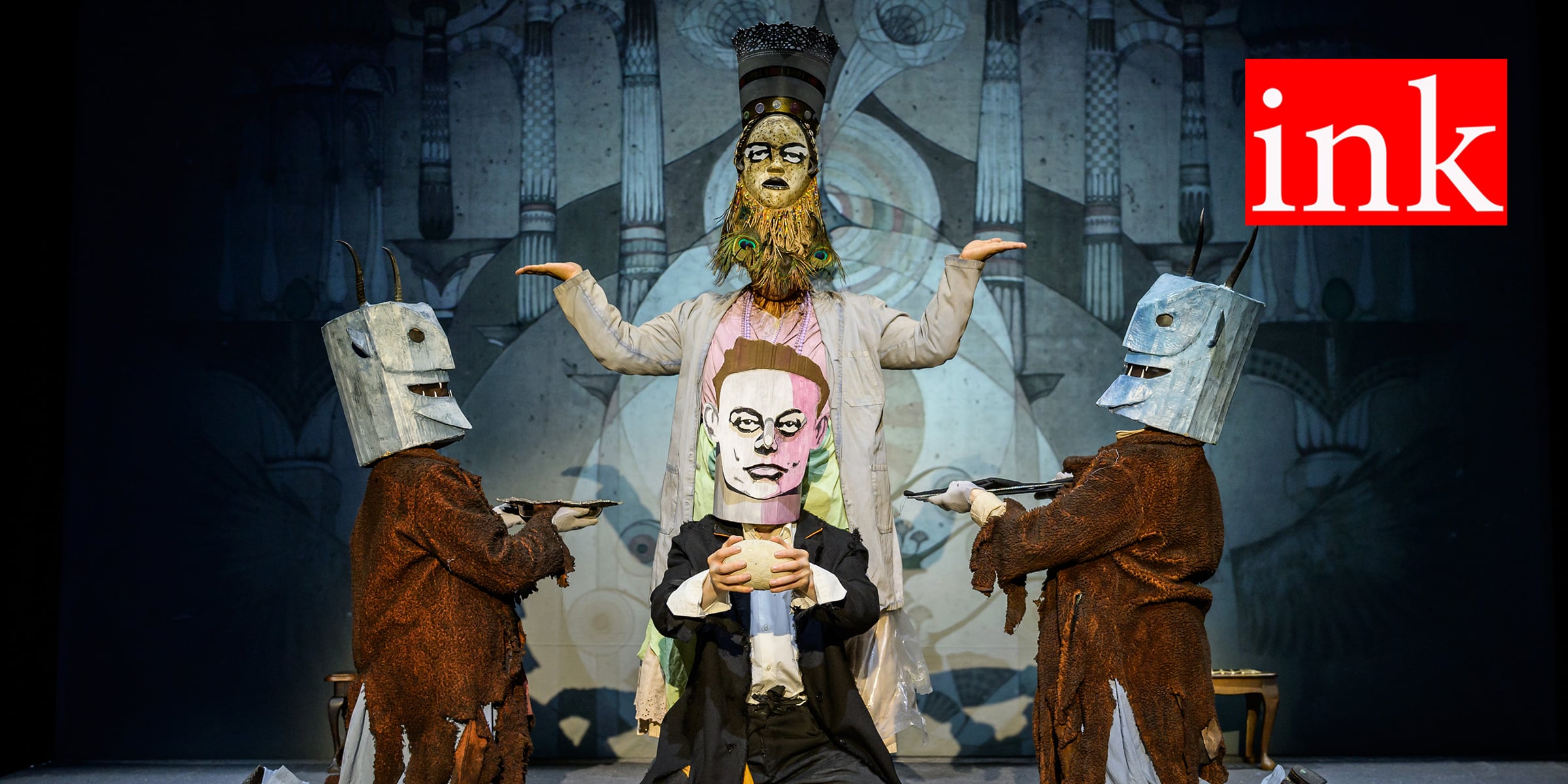
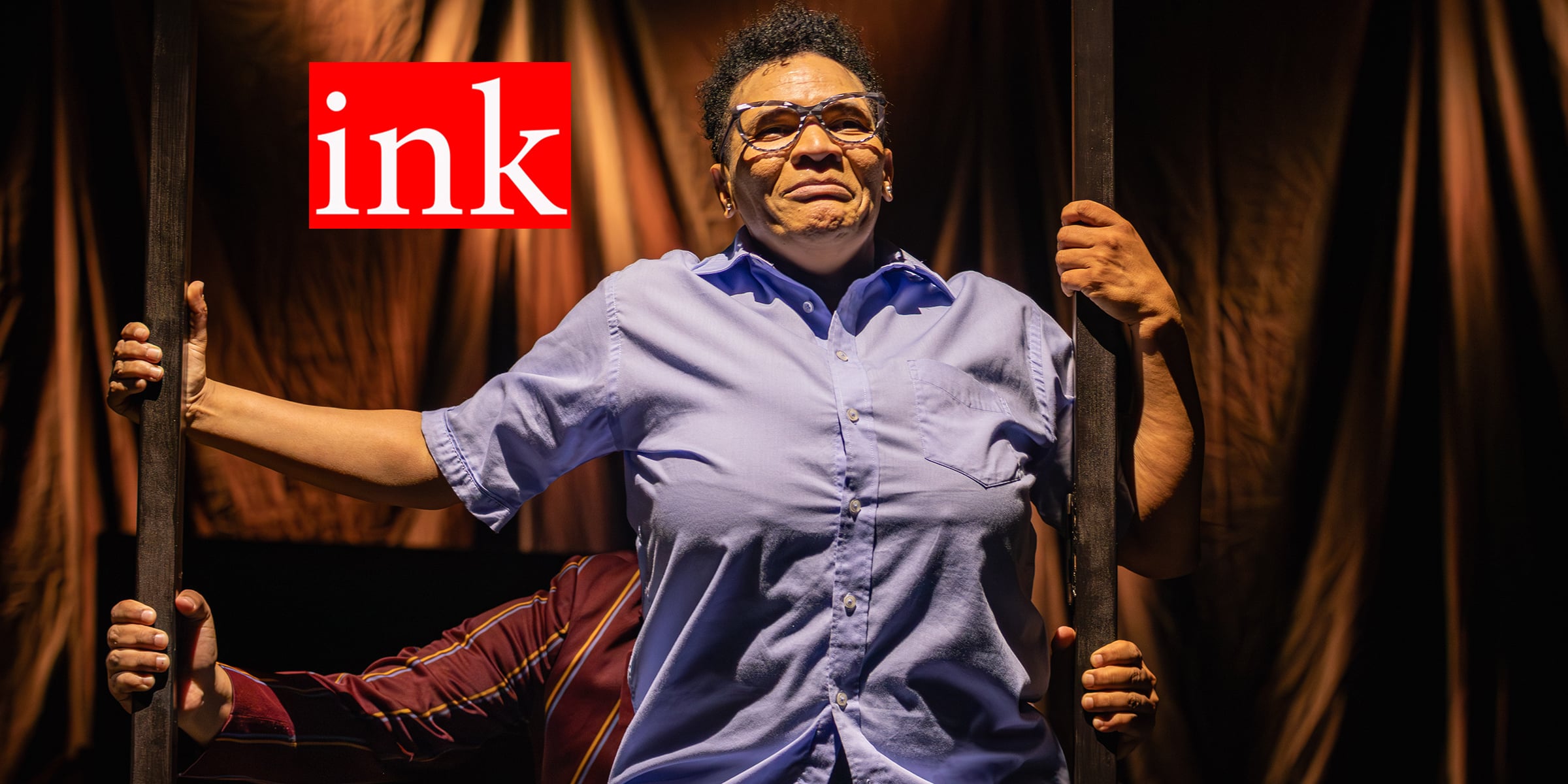
The characters are performed by masked actors, enabling each actor to play several roles. The cast holds the line on stage as the audience enters the auditorium. In their unmasked states, they stand vulnerable yet challenging, prepared to lead us into a battle, and what a battle it is. The extraordinary conglomeration of performers, which draws on skills in dance, puppetry, mime and clowning, forms the bedrock of the production. Their agility and sheer audacity make for the embodiment of the characters and caricatures they bring to life. Despite their concealment, their personal styles are evident, and they retain their individuality beneath the beautifully constructed veneers. Each mask, maquette and wooden carving is an exquisite piece of art, and the masks are worn so adroitly by all the performers; their movements are seamless, and they switch effortlessly between roles. At times, one forgets the separation between the mask and the actor.
The actors are voiceless, and the audible dialogue is predominantly in German with English subtitles and on-screen captions. The visual backdrops are an eclectic smorgasbord of brutalist architecture, Eastern mandalas, Japanese ink drawings, ancient geometry and at least a dozen other art forms. The plethora of designs can be quite heady and disorienting, but as they anchor each chapter and place, they acquire a meaning beyond decoration. Setting a sense of place is also achieved by something as simple as a folded-over carpet. In some scenes, a mini-tableau enacts the main character’s actions simultaneously. Mirroring the action in miniature, it is the ultimate visualisation of the gods making plans while men play. The mixed-media approach to the backdrops applies to the soundscape as well – an aural kaleidoscope, including classical compositions from Handel and Mozart, electronica, chants and ambient sounds from Biosphere and other modern composers.
With all these elements in place, let the games begin. Before the personal bargaining commences, there is wrangling of another kind while a lie of corrupt politicians negotiates with Mephisto. They despair of a country “where corruption rules, lawlessness is law, and despair festers.” Sound familiar? Among the ministers is the president whose presence brings to mind one of Bailey’s earlier villains, Big Dada, a corpulent crony with vast appetites. Mephisto promises them an investor to solve their cash-flow crisis, and with that he departs to bargain with Faust. With a pact sealed, another obstacle appears as the president demands access to “the perfect woman”. A sequence of events unfolds during which Elon is enchanted by Nefertiti (Helen), and their union results in a little Elon, Euphorion. Goethe had modelled Euphorion on the poet, Lord Byron, and spoiler alert: he meets a similar tragic end. With bargaining, euphoria and destruction moving apace, Faust declares his continued ennui, expresses frustration at witnessing the “futile power of unharnessed elements”, and replies scornfully to Mephisto’s offer of fame, “It’s property and power that I want! Fame is bullshit. Action is everything.” With Faust’s eye on both land and ocean, war breaks out, preceded by what can only be described as a ballet of drones. The skilful balancing of drones constructed of unlikely materials encapsulates the preposterous nature of warfare, as the attempts to balance them on poles look precarious, untargeted and random.
The battle ensues, and the crescendo of sound is deafening. There is a barrage of war images, press images overlaid with stock photos and AI-generated graphics, building layer upon layer in a never-ending cycle of obliteration. The de rigueur slogans are placed alongside advertising hoardings offering a forthcoming Riviera. It speaks to the lunacy of the world that this could be a reference to Jared Kushner’s stealth takeover in Albania or his father-in-law’s envisaged real estate plan in Gaza. Either way, the message is clear: ultra-wealthy billionaires plan to make a profit at the expense of anyone who may be in the way. Subsequent scenes present the human cost of the destruction, further destruction, and Elon’s determination to conquer the final frontier: space. Replete with rocket, launch pad and astronaut, the narrative leaves nothing out. Each scene on its own is rendered in vivid detail and, when viewed together, the scenes provide a breathtaking overview of an old story for a new time.
While the subject matter is dark, existential and depressing, there are moments of absurd humour and the entire project is imbued with a sense of play and creation, almost in defiance of the overriding impetus to destruction. FaustX is a total assault on the auditory, visual and emotional sensibilities, but there is enough play in its execution to hold your gaze and maintain your focus despite the visceral urge to turn away.
FaustX is less black and white than one would have anticipated, with ideas of motive and intention providing space for shades of grey. In God’s initial dare to Mephisto, God tells him that “a good man, even with dark drives, always finds the righteous path”. The closing epitaph hints at a redemption of sorts, although the frontiers of the ocean and space seem within easy reach compared to finding a substantive level of decency or righteous action among the oligarchs and tech bros. However, perhaps the error lies in how we search, not that for which we search. What are we prepared to relinquish to the algorithm in our individual Faustian pacts to the seductive allure of better, faster and more? FaustX is a visual, phantasmagorical morality tale that will have you pondering your individual role in a world where technology and power seem to be hurtling towards a collision course of their own making. What would you trade for a front-row seat at the end-of-time pyrotechnic show?
FaustX 5 OCT | 19:30 Adam Small Auditorium R350–R380 at the door