At just 40 minutes, Wonde is a brief work of heart and authenticity that leaves a lasting impression because it does not shy away from the responsibility of telling a difficult story and naming a collective failure, writes Gillian Mitchell.
We live in a world in which children are not safe. We live in a world in which girls and women are not safe. It seemed appropriate to be watching Wonde, the production that highlights the effect that the loss of a child has on individuals, families and communities, in October. Established nationally and observed globally, October is the month in which special attention is directed to the scourge of domestic and gender-based violence that continues to bloom in our societies.
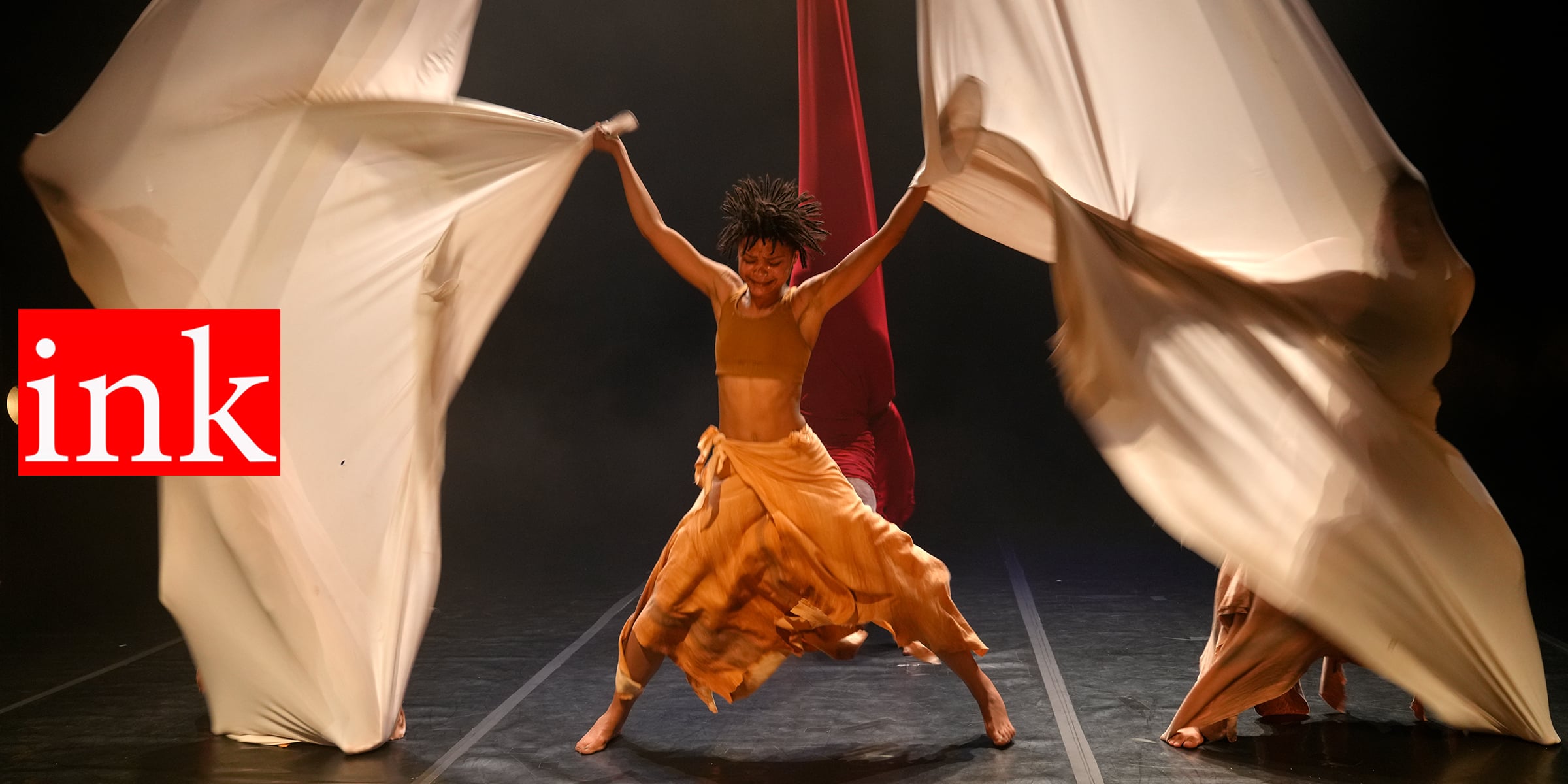
Despite being a dance work in which movement is constant, Wonde resounds with images – like carefully placed snapshots – throughout the performance, evoking worlds that belie the ebb and flow of the choreography.
Long strips of white and red cloth float down onto the stage. The dancers become entangled, entrapped, connected and concealed within them. These lengths of fabric, and the ways in which they are used throughout the work, will resonate differently for each audience member. For me, they felt like blood and plasma: essential components of a healthy body and, by extension, healthy communities. The white of safety. The blood-red of connection. When these bonds are broken, our children are not safe. Our families are riven by loss and our societies diminish.
The young dancers perform with absolute commitment. They are 100% all-in, and it shows. There is never a moment when the authenticity of their connection to the movement, or to the story being told, is in doubt, and the performance never falls into graphic imitation.
Images reminiscent of the Sufi whirling dervishes connect the dancers to a tradition that seeks the loss of self in pursuit of something greater. In Wonde, there is the sense of movement being used as a way of avoiding difficult realities. If one is always in motion, the weight of reality never has the chance to settle.
Then there are the three hooded figures evocative of medieval executioners: waiting to end, to bring death, to initiate sorrow and to become the cause of unending grief. The spectres that shadow the lives of thousands of young people who are trafficked, kidnapped, stolen, murdered.
Wonde is a work of heart and authenticity. The young dancers perform with absolute commitment. They are 100% all-in, and it shows. There is never a moment when the authenticity of their connection to the movement, or to the story being told, is in doubt, and the performance never falls into graphic imitation.
Using their bodies to suggest, reflect and evoke the emotions wrought by loss, they create images of beauty that give shape to sorrow.
At times, I experienced the choreography as a little naive, and some of the musical choices lacked complexity, straying close to the line of cliché.
Yet as the final light dimmed, the under-25s, who made up almost half the audience, leapt to their feet with a roar. In that moment, I realised that Wonde was speaking two languages. One challenged my generation, refusing to allow us the comfort of passive observation and instead confronting us with a nagging discomfort, a scratchiness about what is happening on our watch. The other spoke directly to young people, reflecting their experiences, their fears and their realities.
Byron Klassen understood exactly who his audience was, what experiences they were bringing into the theatre, and how to connect with them.
At just 40 minutes, Wonde is a brief work, but one that leaves a lasting impression. Perhaps that is because, at its heart, it does not shy away from the responsibility of telling a difficult story and naming a collective failure. In doing so, it asks hard questions of its audience, regardless of age.
Wonde 5 OCT 17:00 Adam Small Laboratory R150-R220 | R180-R250 at the door